
Washing the American Flag
Meaningful anniversaries always catch the United States with its pants down. That's no reason to abandon patriotism.

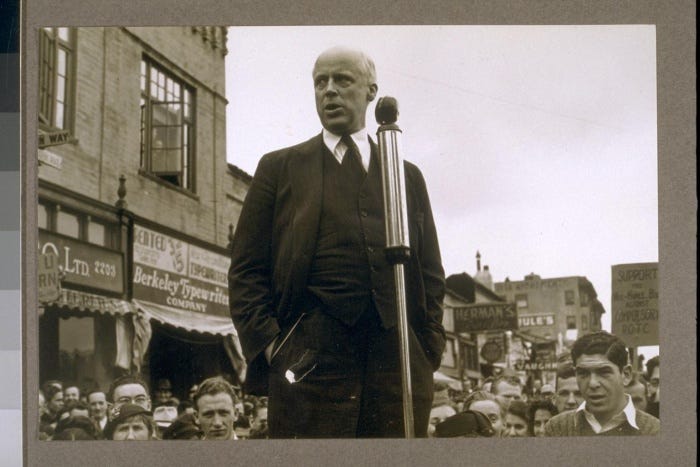
Norman Thomas giving a speech in Oakland, California, courtesy of Bancroft Library, University of California.
That dull throbbing in your head tells you the United States is about to celebrate a meaningful anniversary.
I consider myself a patriot, and just last night I found myself taking the side of Old Glory in a never-ending family argument over whether liberals should display the American flag. I’m recovering from a Covid booster that gave me too much of the real thing and didn’t hold up my end very well. Here’s what I’d like to have said.
At a time when democratic socialism is all the rage, patriotism possesses impeccable socialist credentials. The Pledge of Allegiance was written by Francis Bellamy, a Christian socialist minister and cousin to Edward Bellamy, author of the novel Looking Backward, which in 1887 extolled the socialist utopia that would dawn the 21st century. (Whoops!) Francis wrote the pledge (which in his version mentioned neither the United States nor God) a year after he got booted from his Boston pulpit for being too pink. (Read all about it in People’s World, successor publication to the Daily Worker.)
Norman Thomas, the six-time presidential candidate on the Socialist ticket, gave a speech in 1967 at the height of the Vietnam war and on the eve of his 83rd birthday. The New York Times described him as “Blind, crippled by arthritis and an automobile accident, his face chalky white from heart trouble.” Thomas would die the following year. (Fun fact: I later worked for his grandson.) Here is what the old Red said:
I don't like the sight of young people burning the flag of my country, the country I love. A symbol? If they want an appropriate symbol they should be washing the flag, not burning it.
Amen. I’m grateful to Jack Beatty of the New Republic and later the Atlantic, for introducing me to the Thomas quote in his excellent New Republic essay from July 1981, “The Patriotism of Values.” New Republic subscribers can access the essay here.
If it’s any comfort on the occasion of America’s (unpronounceable) semiquincentennial, these anniversaries have a way of catching the last, best hope of earth with its pants down. This year the country whose founding we celebrate is witnessing the most corrupt presidency, by far, in American history. No other president comes close to debasing the office as Trump has done. That’s the subject of my latest New Republic piece, pegged to release of President Donald Trump’s dumbfounding financial disclosure, which of course doesn’t tell the half of it. We patriots have a lot of washing to do! (Maybe that’s why they call it Washing-town.)
But the bicentennial was no bargain, either. The Watergate scandal had set what at the time seemed an unbeatable standard for corruption in the American presidency, and the Vietnam war had ended with a whimper the year before. My own contribution to the celebrations was as editor of the Beverly Hills High School newspaper, Highlights, which produced a special bicentennial issue. By far the worst thing in it was a (thankfully unsigned) editorial under the headline, “Beverly Hills Can’t Relate to Bicentennial.” It was full of the worst kind of teenage anomie and unearned cynicism about the festivities’ remoteness from a pampered community that at the time of the founding was a ranch under Spanish rule. “It’s hard to work up too much enthusiasm for something that happened in 13 colonies that lay 3000 miles away,” the editorial said. I could tell you who wrote it, but then I would have to kill you.
Before the bicentennial we had the centennial, which, Fergus Bordewich’s excellent recent history Centennial reminds us, found the nation in significantly worse shape than in 1976 or even 2026. We flatter ourselves to think otherwise. The oligarchic Gilded Age was in full swing, Congress and many political appointments were openly for sale, and President Ulysses S. Grant, though honest as far as we know, was not really up to the job of doing anything about any of this. (Good general, though.) Railroad workers whose meager pay was being slashed during the worst depression the United States experienced up to that time were being murdered en masse, and so were Black freedmen who dared participate in civic life. Native Americans were being slaughtered to make way for the railroads, the survivors rounded up into reservations little better than prisons. To settle the contested presidential contest between the Republican Rutherford B. Hayes and the Democrat Samuel Tilden, the Republicans got the presidency and the Democrats got the withdrawal of federal troops from the South, the end of Reconstruction, and the near-reestablishment there of slavery in the formalization of racial caste known as Jim Crow. Another century would pass before the country even started doing anything to right this historic wrong.
Balanced against all that we got a lot of powerful machinery, put on display at the Great Centennial Exhibition in Philadelphia’s Fairmount Park, along with Alexander Graham Bell’s new telephone, which would create a remarkable new form of aural communication that lasted for 132 years. Now, the invention of the telephone was something to celebrate, but today the telephone conversation is a thing of the past. I eulogized it ten years ago in Slate, in one of the better essays I ever wrote.
This is all a long-winded way of providing you some solace for my depressing latest piece for the New Republic, about the triumph of Donald Trump’s rentier presidency. You can read it here. Happy July 4 to all who celebrate. We’re in terrible shape, but we’ve been in worse, and if you aren’t a patriot then you don’t accept responsibility for cleaning up this mess. I’m in Montana this week, but if I were home I’d be flying the flag, after a good scrubbing.